Watch 07
The Bend, Which Is the Hardest Thing a Long Hull Does Here
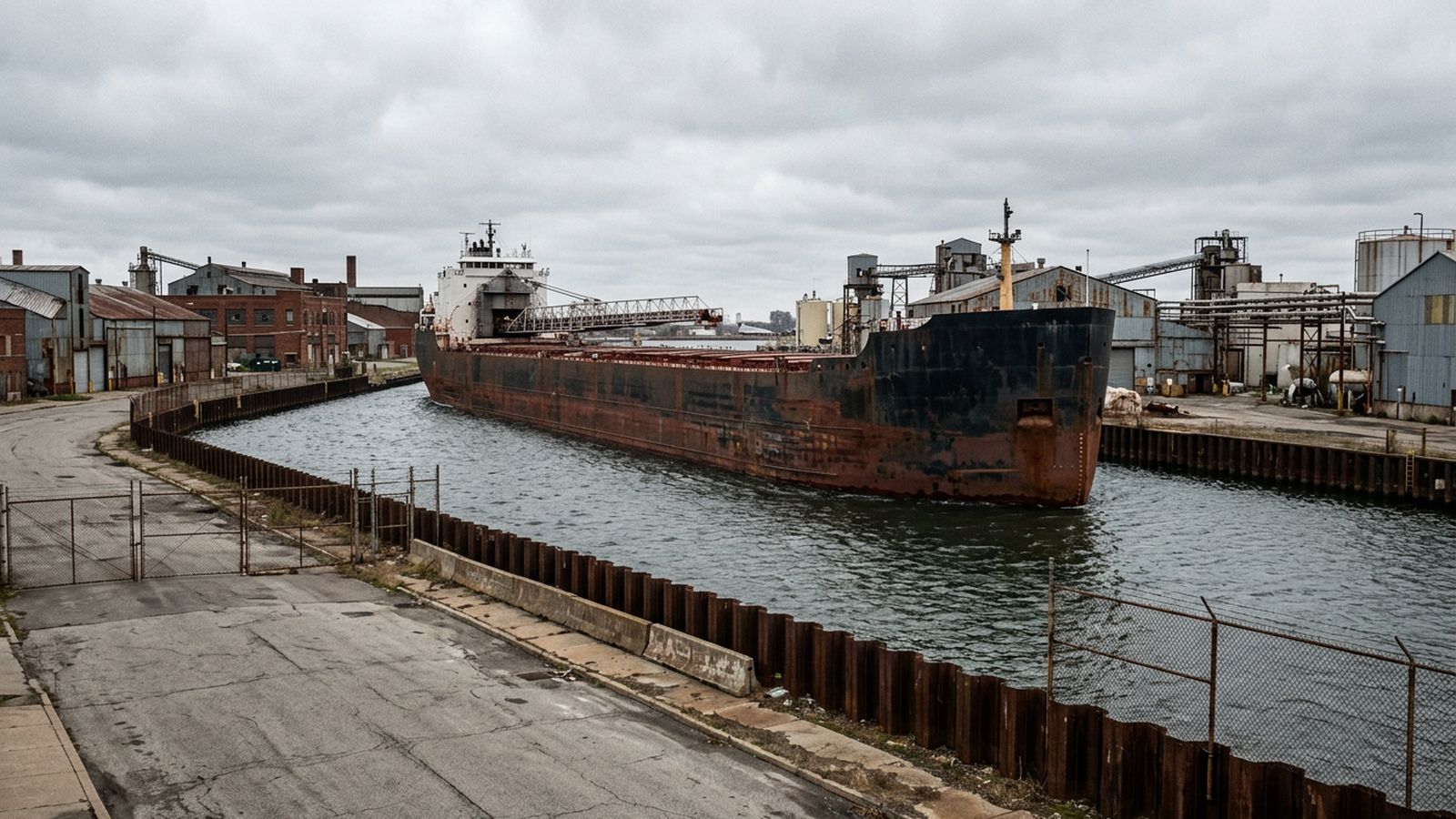
Where you stand: a street end on the inside of the bend, with the span sidewalk above it as a second position. What is wrong with it: the whole event is slow, the good sight line changes as the hull comes round, and you will be there a while.
Why a bend is the whole problem
A channel cut through an industrial valley follows the river it replaced, and rivers bend. A hull that is a great deal longer than the channel is wide therefore has to do something that is not obvious: get round a corner without room to turn.
The answer is that she is not turned. She is worked, in a sequence of small deliberate actions that each solve part of the problem, and the sequence is the most skilled thing that happens in public view anywhere in this subject.
What working her round looks like
From the bank, this is what you see, and the order matters.
She slows down more than seems necessary. Long before the bend. Momentum is the enemy of a maneuver in a confined channel, because momentum cannot be argued with once it exists.
The bow starts across before the bend does. The turn begins early and gently. If you are watching the bow you will think she is heading for the bank, and that impression is the correct reading of a maneuver that is working.
The stern walks. This is the part worth being there for. As the bow comes round, the stern is pushed the other way, and for a period the hull is not aligned with the channel at all. She is diagonal in a space that looks too narrow to be diagonal in.
There is help. Depending on the vessel and the bend, that may be a thruster, or another vessel pushing, and either way the help is applied in short bursts rather than continuously. Watch for water disturbance where nothing appears to be happening: that is a burst of thrust doing its work.
Then she straightens, slowly, and the whole thing has taken longer than a person watching for the first time would believe.
Why the closure runs long
If there is a movable span at or near the bend, this is why its closure is longer than the closure at a span on a straight stretch, for the same vessel on the same day.
A hull on a straight run passes a span at whatever speed she is making. A hull being worked round a bend at a span passes at whatever speed the maneuver allows, which is much less, and with pauses in it. The bridge is open the whole time.
So a nine minute closure on a straight stretch is a fourteen minute closure at the bend, and the driver waiting at the gates has no way of knowing why. If you have stood at both, you do. The ten minutes before a boat covers the span end of this.
Where to stand, and the two positions
Inside of the bend, at a street end. This is the close view and the better one. From the inside you see the hull come round toward you and past you, and the diagonal moment is at its most obvious because you are looking along the line she is not aligned with.
The span sidewalk above it, on the fixed approach. The second position, and the one to move to if a span is going to open. Higher, less detail, but the geometry of the bend is visible in a way it is not from the bank.
You will not get both for the same vessel. Pick one and stay, because moving between them takes longer than the event.
What determines how hard it is
Four things, all of them readable from the bank.
| What | How you can tell | Why it matters |
|---|---|---|
| Length | Compare her against the channel width | A longer hull has less room to be diagonal in |
| How deep she sits | How much side plating is above the water | Loaded is slower to start and slower to stop |
| The wind | Whatever it is doing to you | A high empty flank is a sail, and empty is harder than loaded |
| Direction of travel | Which way she came from | Coming round with the current is a different problem to coming round against it |
The counterintuitive one is the third. People assume a loaded hull is the difficult case because it is heavy. In a confined channel an empty hull is often harder, because she rides high, presents an enormous flank to the wind and has less of herself in the water to hold a line.
The thing to notice, if you notice nothing else
How little happens quickly. There is no moment of decisive action in this at all. It is a slow accumulation of small corrections, applied early, by people who have decided in advance what they are going to do and are not going to be hurried out of it.
That is the actual character of the work in this valley, and this is the one place you can watch it undisguised.