Watch 01
The Ten Minutes Before a Boat, in the Order They Happen
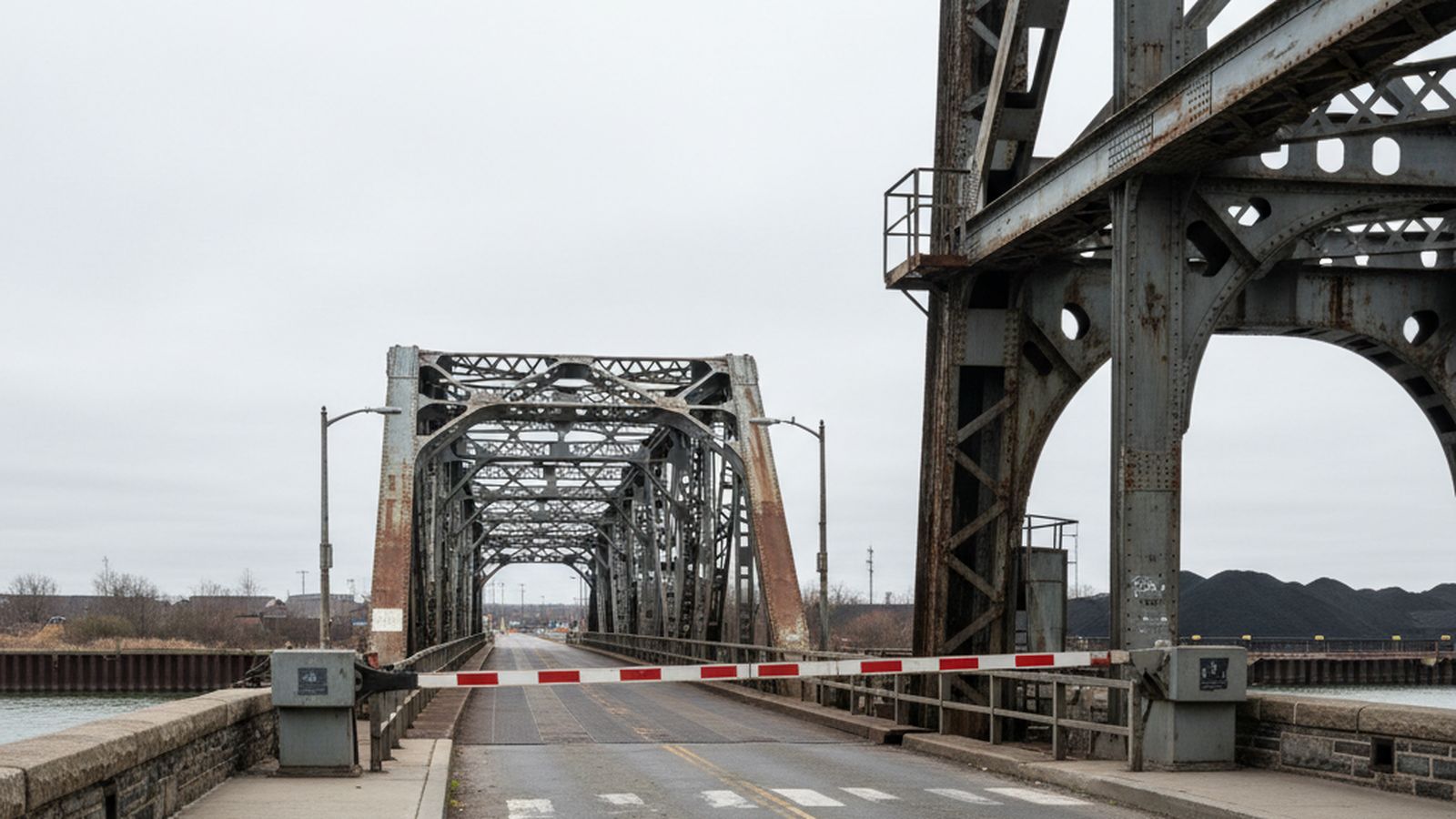
Where you stand: the fixed approach of a span sidewalk, not the movable deck. What is wrong with it: road traffic a few feet behind you, a narrow walkway, and the fact that the moment you came for is the moment you must already have left the deck.
What everybody expects, and what actually occurs
Ask somebody what a bridge opening looks like and they describe the deck going up. That is the shortest part of it. On a working span an opening is around nine minutes from the first bell to traffic moving again, and roughly ninety seconds of that is the deck in motion.
The other seven and a half minutes are the interesting part, because they are procedure, and procedure is where you can see what the people running the thing are actually worried about.
Minute zero: the signal
You hear it before you see anything. A prolonged blast, then a short one, out on the water somewhere you cannot see yet because of the bend. That is a request. The answer, if it comes, is the same signal back.
Sometimes there is no whistle at all, because radio does the same job and does not annoy anybody within a mile. Do not conclude from silence that nothing is happening. The better indicator is the operator's house: a light, a movement behind glass, a change in what somebody up there is looking at.
Minutes one to three: the road
The bells start. Then the gates come down, and this takes as long as the road takes to empty, which on a working street with trucks on it is the slowest part of the entire sequence.
Watch the sequence rather than the gates. Bells first, then a pause, then the first gate, then another pause, then the second. The pause is not hesitation. Nothing comes down until the previous thing has confirmed, and a gate that will not confirm stops the whole opening.
This is also the moment when a person standing on the movable deck becomes a problem. If you are on the leaf when the gates come down, somebody has to notice you, and everything waits until you are off. Stand on the fixed approach and this never involves you.
Minutes three to four: the lock bars
The sound is the best thing on this list. Two heavy mechanical clunks, several seconds apart, from somewhere under the roadway.
Those are the lock bars retracting. A movable span, when closed, is not simply resting in place: bars or wedges carry load across the joint so the deck behaves like a continuous structure under a truck. Before the deck can move, they have to come out.
If you have found a place where you can see the joint in the roadway, you can watch this happen. If not, you can hear it, and hearing it is enough to know that the next thing is movement.
Minutes four to five: the deck
Now the ninety seconds everybody came for.
On a vertical lift, look at the towers rather than the deck. The deck rising is obvious. What is worth seeing is the counterweight coming down inside the tower at the same speed, because that is the entire reason the thing is possible: the motor at the top is not lifting a bridge, it is overcoming friction and wind against a load that has been very nearly cancelled out.
The deck stays level the whole way, which makes it read as a horizontal line moving up a vertical frame. It stops at its clearance and holds.
Minutes five to eight, or longer: the hull
This is the most variable part and the part that catches out anybody who came with a train to catch.
A long hull moving slowly through a channel takes as long as it takes, and if the channel bends, it takes longer, because the hull has to be worked around the bend rather than driven around it. Nine minutes is a normal closure. Fourteen is not unusual. The bridge is not being slow. The bridge is waiting, same as you.
From the fixed approach this is the best view you will get of a hull at close range: the flank going past below you, the rubbing strakes, how much of the side plating is out of the water, which tells you whether it is loaded or empty.
The last two minutes: everything backwards
Deck down. Lock bars back in, two clunks in the other order. Gates up. Bells stop. Traffic moves.
The lock bars going in are the thing to wait for. Until they seat, the road cannot open, and a bar that will not seat is the commonest reason a closure runs long after the hull has gone. If you are watching and the deck has been down for two minutes with the gates still closed, that is what is happening, and you are watching the most interesting failure available on an ordinary day.
What to bring, and what to expect
- Time you do not need. An opening is not scheduled. You may wait an hour and see nothing.
- Nothing that needs setting up. A tripod on a narrow span sidewalk is a nuisance to everybody and a hazard on a street with trucks.
- The habit of listening. Every stage of this announces itself before it becomes visible.
- A plan for leaving. If the gates come down while you are on the leaf, walk off it immediately and without discussion.
If nothing opens
You have still seen a machine at arm's length, which is more than any photograph gives you. Find the counterweight track. Find the joint in the roadway. Find the operator's house and work out which direction its windows favor, which tells you where the traffic they care about comes from.
How a lift span works is the companion piece to this one, and one long, one short is about learning to hear the signal properly.