The mechanism
How a Movable Span Works, and What the Handful of Minutes Is Spent On
A movable bridge is a structure that concedes it is in the way. Two designs solve that here, both by refusing to lift their own weight, and most of an opening is spent on things that are not the lifting.
The problem both designs solve
A bridge over a navigable channel has two jobs that contradict each other. It has to carry a road across, and it has to let a hull through that is taller than the road. Fixed high bridges solve this by going up and staying up, which costs enormous approach ramps and a lot of land. Where the land is not available, the deck moves.
Moving a bridge deck sounds absurd until you notice that nobody moves the weight. Both designs here balance the deck against a counterweight of nearly equal mass, so the machinery is not lifting hundreds of tons: it is overcoming friction, wind and the small deliberate imbalance the designers left in on purpose. That is the whole trick, and everything else is arrangement.
Vertical lift
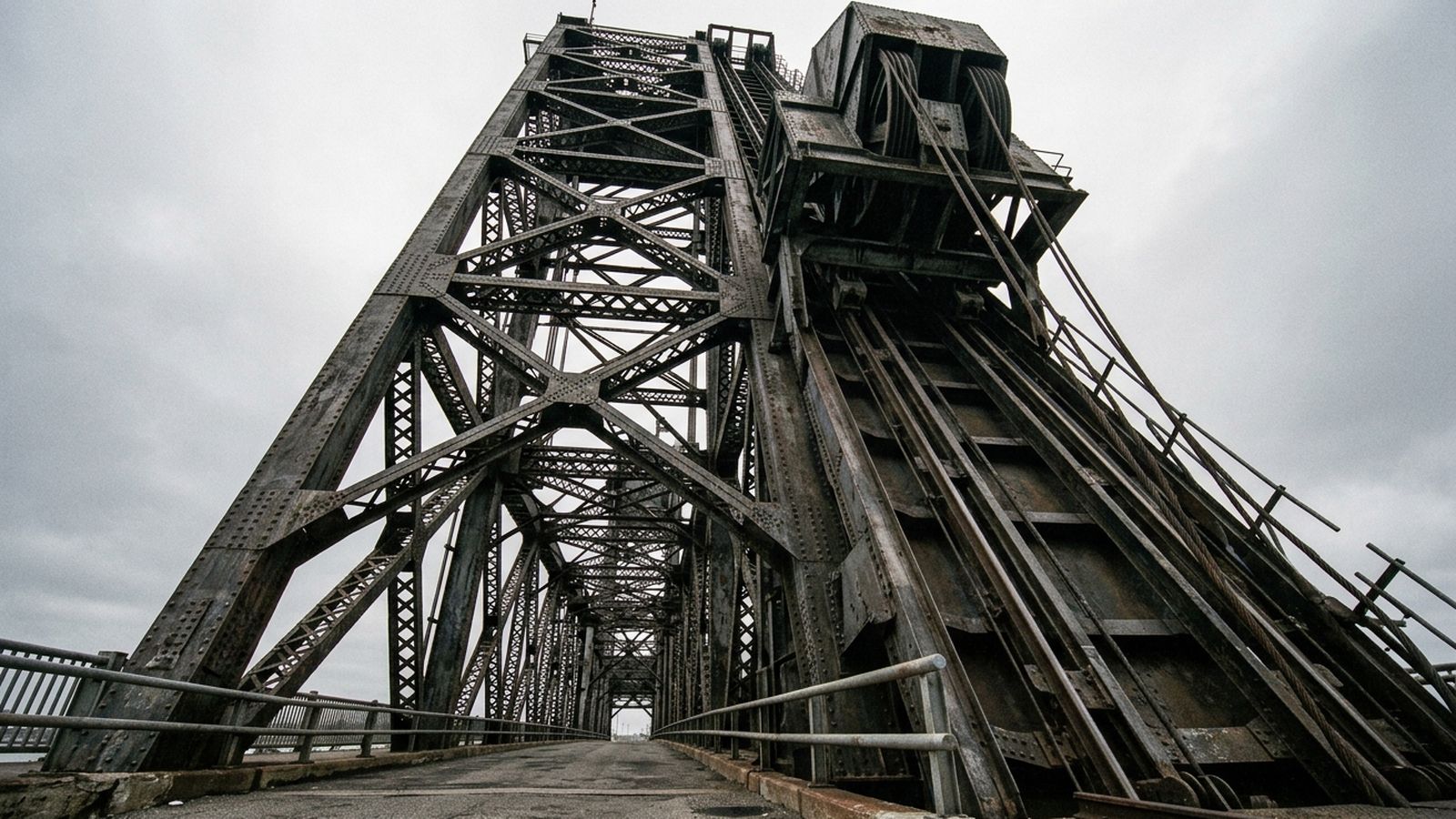
Two towers, one deck, and a set of counterweights inside or beside the towers. Cables run from the deck up over sheaves at the top of each tower and down to the counterweights. When the deck rises, the counterweights come down the inside of the towers, and the two masses very nearly cancel.
From the sidewalk you can watch this directly, which is what makes a lift span the better one to see first. The deck stays level the whole way, so you can follow a horizontal line rising against the towers, and if you look at the tower legs rather than the deck you can see the counterweight coming down as the deck goes up. Two things moving in opposite directions at the same speed is a very legible piece of machinery.
The deck is guided in the towers, so the amount of daylight it can produce is limited by tower height. Lift spans therefore rise to a set clearance and stop, rather than opening indefinitely.
What limits the height
Tower height, cable length and the depth of the counterweight pit. That is why a lift span gives you a horizontal deck hanging in the air at a fixed level rather than getting out of the way entirely, and why a hull with an unusually tall structure can still be a problem for a span that opens perfectly well for everything else.
Bascule
A bascule leaf rotates around a horizontal pin near the shore end, so the roadway tips up and the channel end swings away. The counterweight sits behind the pin, usually in a pit under the approach, and comes down as the leaf goes up. A single leaf bascule does this from one side. A double leaf meets another leaf in the middle, and the two have to be within a very small tolerance of each other before the locks between them will engage.
A bascule opens further than a lift, because nothing above it constrains the leaf, and it can therefore serve a taller hull. It is fussier. The pin, the racks and the pit all have to be maintained, and a double leaf has to be kept in agreement with its own other half.
Watching one is a different experience from watching a lift. The motion is rotational, so the far end of the leaf travels much faster than the near end, and the sight lines change constantly as the deck tips. The moment worth waiting for is not the top of the swing: it is the first inch, when the leaf breaks free of its seat and you can see that something enormous is now free to move.
The sequence, which is most of it
Nobody times an opening by the moving. Here is where the minutes actually go.
- 1. The request. A hull asks for the span. Historically and still, that is a whistle signal, and the answer comes back the same way. See below.
- 2. Traffic gates. Bells start, then the gates come down across the roadway, and on a busy street this is the slowest part, because the gates cannot come down until the road is clear.
- 3. The check. Somebody confirms the deck is empty. On a span with a sidewalk this means confirming the sidewalk is empty too, which is why standing on the deck of a span that is about to open is not a plan.
- 4. Lock bars. A movable span is held in place when closed by bars or wedges that carry load across the joint. Those retract before the deck can move, and the sound is distinctive: a heavy, short, mechanical clunk, twice, some seconds apart.
- 5. The move. Thirty seconds to about two minutes, depending on the span and how far it has to go.
- 6. The hold. The span sits open while the hull passes, and this is the longest and most variable part. A long hull moving slowly through a bend takes as long as it takes.
- 7. The reverse. Everything above, backwards, and the lock bars going back in are the last thing to happen before the gates lift.
Read that list again and notice that of a nine minute closure, perhaps ninety seconds is bridge movement. The rest is procedure. That is the single most useful thing to understand before you go and stand at one, because it stops you assuming that nothing is happening.
Whistle signals, briefly
The signal to request an opening is one prolonged blast followed by one short blast. The bridge answers with the same signal to mean yes, it is opening. A rapid series of short blasts from the bridge is a refusal, and it means something is wrong or the span cannot be opened at that moment.
Two practical notes. Modern practice uses radio as well, so you may see a span open with no whistle at all. And a prolonged blast is genuinely loud at close range: if you are standing at a bridge sidewalk and you hear one begin, that is your cue to be off the deck, not your cue to walk out onto it for a better view.
The piece one long, one short is about listening for this properly.
What can go wrong, and what that looks like
Openings fail. Usually it is undramatic: a gate that will not confirm, a lock bar that will not seat, a leaf that will not agree with its opposite number. What you see from the sidewalk is a span that starts to move, stops, and goes back down, followed by a long wait while somebody works out why.
If you are watching and this happens, you have seen the most interesting thing available that day, and the correct response is to stay where you are rather than leave. The second attempt usually tells you what the first attempt was missing.
Reading a span before it moves
You can tell a good deal standing at a closed span.
- Look for the counterweight. If it is visible in a tower, it is a lift. If the approach roadway hides a pit and there is a large pin housing at the shore end, it is a bascule.
- Look at the joint in the middle of the roadway. A double leaf bascule has one, and it is finished differently from an ordinary expansion joint.
- Find the gates. Their position tells you where the deck of the movable section begins, which is not always where you would guess.
- Find the operator's house. A movable span is run by a person in a room with sight lines down the channel, and locating that room tells you which direction the traffic they care about comes from.