Watch 02
What a Working Valley Looks Like From Above Its Own Roads
Where you stand: the sidewalk of a high road viaduct. What is wrong with it: constant wind, heavy traffic beside you, and everything below is small enough that detail is lost.
Why start above it
Because from up here the subject is an arrangement rather than a set of objects, and everything you do afterwards happens inside that arrangement.
At water level a channel is a thing in front of you. From a viaduct it is a plan: you can see which way it runs, where it bends, where the docks are and which of them has something at it today, and how the rail lines cross above and below the road you are standing on. Twenty minutes here saves an afternoon of confusion.
The first thing to work out: the bend
Almost every difficulty in this valley comes from the fact that the channel does not run straight. A hull that has to be worked around a bend takes longer than a hull that does not, which is why a closure at one span can be much longer than a closure at another for the same vessel.
From above you can see the bend as a geometric fact, and you can see which spans are on the inside of it. That tells you which span will hold traffic longest, and therefore which one is worth standing at if you want a long look at a hull and which one if you want to be somewhere else quickly.
The second thing: the spans, in relation
Movable spans are hard to compare from the ground because you never see two at once. From up here you often can.
What to look for. Which of them has towers, which has a pin housing and a pit. Which of them sits on the inside of the bend. How far apart they are, which determines whether a hull is between openings or in both at once. And where the operator's houses are, because their windows tell you which direction each of them is watching.
The third thing: a freight deck from above
This is the view almost nobody thinks to look for and it is the best thing on this list.
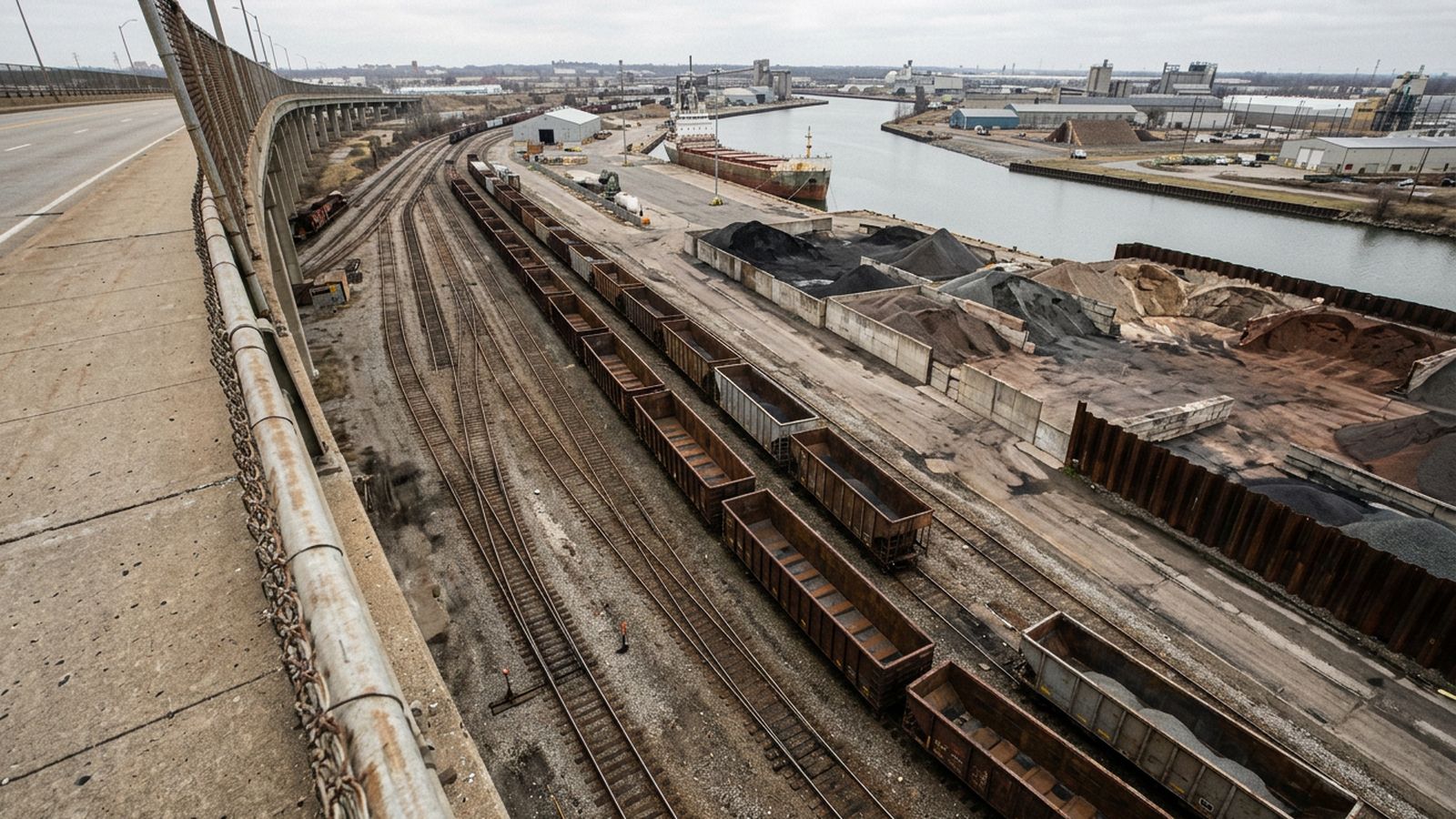
A road viaduct crossing an industrial valley usually crosses rail as well as water, and it often crosses the rail at a height that puts you directly above a freight deck. What you get is a plan view of rolling stock: the tops of hoppers, the arrangement of a string of cars, the way a yard is laid out to let a cut of cars be worked without blocking the through line.
You cannot see any of that from ground level, where a train is a wall. From above, a yard is a diagram of its own logic.
The fourth thing: cargo at rest
Stockpiles read differently from above. At street level a pile is a slope. From up here you see its footprint and its axis, and the axis tells you where the boom was standing when the pile was built.
Ore piles are darker, denser and lower for their volume. Stone is coarser, steeper and slumps. Salt is under a roof, so from above the salt operation reads as a building rather than a pile, which is the clearest illustration available of why salt behaves differently from everything else here. What moves through takes the four cargoes apart properly.
What is wrong with standing here
Three things, all of them real.
The wind. A high exposed deck has wind on it constantly, and it does not stop for you. Twenty minutes is about the length of time this is pleasant, which is conveniently about how long the view takes.
The noise. Heavy traffic a few feet away on a hard deck is louder than you expect and gets tiring faster than you expect. It also means you will not hear a whistle from the water, which is the main thing you lose by being up here.
No detail. Everything below is small. You will not see a lock bar, you will not hear a bell, and you will not be able to tell a loaded hull from an empty one with any confidence. This is a plan view, and a plan view is not an observation of machinery.
What this place is for, and what it is not
It is for orientation, and it is the best orientation available. It is not the place to spend an afternoon, and it is not the place to see an opening properly: from up here an opening is a small horizontal line moving slowly in the middle distance.
Do this first, then come down. A first visit puts it in that order for exactly this reason.